Overview

Mandatory Exchangeable Notes - Key Structuring Issues

Standard Exchangeable Notes - Key Structuring Issues

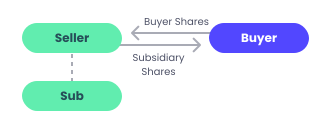
Transaction Structure

Step 1 - Stock-for-Stock Exchange
stock-for-stock
  • Buyer acquires Sub shares from Seller in exchange for Buyer common or convertible preferred stock
  • If Buyer convertible preferred stock is utilized, must constitute participating preferred stock of long-term preferred stock (i.e. maturity of at least 20 years) to qualify as tax-free to Seller
Step 2 - Monetization
stock-for-stock
  • Seller enters into a derivative capital markets transaction or a derivative with its investment bank with respect to its Buyer shares, which monetizes the shares without triggering any current tax liability

Exhibit 6.14 – Exchangeable Notes - Advantages & Disadvantages

  Advantages Disadvantages
Mandatory Exchangeable
  • Seller maintains ownership of Buyer shares until conversion
    • Receives dividend and has voting rights
    • Captures Dividends Received Deduction
  • Certainty of sale at current market price of higher while taxable event deferred until shares sold or delivered
  • High coupon costs
  • Interest is likely to be capitalized into basis in shares under Straddle Rules
  • Hedge Accounting - possible to structure with no mark-to-market mismatch
Standard Exchangeable
  • Seller maintains ownership of Buyer shares until conversion
    • Receives dividends and has voting rights
    • Captures Dividends Received Deduction
  • Provides for long-term deferral of capital gains taxes on appreciated shares
  • Not a definitive sale of Buyer shares
  • Longer-term structures will result in high coupons or lower conversion premiums
  • Interest is likely to be capitalized into basis in shares under Straddle Rules
  • Under FAS 159, possible to mark-to-market instrument with underlying asset to avoid mismatch caused by earnings volatility

Exhibit 6.15 – Comparison of Monetization Alternatives

Alternative Risk Transfer Monetization Tax Accounting Credit
Mandatory
Exchangeable
Complete elimination of downside exposure; some retained upside interest Full Deferral for 3-5 years; interest capitalized in excess of yield on underlying security Hedge accounting available; little earnings volatility Little net credit impact
Traditional
Exchangeable
Some retained upside interest; full downside exposure Full Deferral for 5-30 years; interest capitalized in excess of yield on underlying security FAS 139 permits mark-to-market election; little earnings volatility Substantial credit impact (on balance sheet financing)
Collar/Loan Small upside interest and downside exposure (i.e. within collar) Less than full (ability to leverage non-recourse against asset) Deferral for term of collar/loan, typically 1-5 years; interest capitalized in excess of yield on underlying security Hedge accounting available; little earnings volatility Little net credit impact (non-recourse loan)